This critical analysis deals with pages 164 -165 of the 2019 peer-reviewed article titled, ‘Tomorrow We Make it Better’: An Art Therapist’s Reflection on a Community Mural in a Refugee Camp in Greece, by Emily Hollingsbee, found in International Journal of Art Therapy, Volume 24: No. 4 158-168. Emily lives in London and works as an art therapist, artist and educator. She has co-established the not for profit organisation ‘Draw On’, which offers art therapy informed services for displaced communities in and around London, and workshops focusing on art making, resilience and self-care. She is interested in how an art therapy practice can be applied to address the psychological and social needs of communities. The paper examines the ‘psychosocial’ approach within art therapy. It also discusses ideas on working outside the art therapy room and theories relating to the healing elements in a therapeutic art making process.
The article appealed to me because I am interested in helping to heal people through art who have gone through extremely traumatic experiences; such as of losing their homes and family members and are looking to rebuild a life somewhere new. It is inspirational to me that art therapists have gone over to help people improve their lives through the use of art. I am aware of the therapeutic effect that art therapy can have on people in changing their lives as it has helped me throughout my life. I chose this article because it is a good insight into the refugee community which is needed in this area, we need more art therapists helping people in this way. Art and community is very important to us all it helps increase our wellbeing and more can be achieved when we work together.
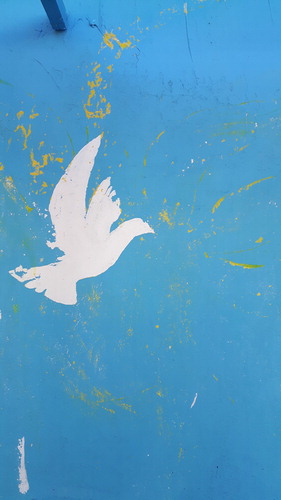
The article is about an art therapist’s time in a refugee camp in Greece and how she helped facilitate a group mural project. She discusses the therapeutic value the mural has, and the benefits of an art therapist facilitated project. She explains how the community comes together to create the piece, the conflicts which occur and the hurdles they overcome to create a piece of hope for the future of the community. One man takes all the ideas that have come up and creates a vision which they use of the sea in the middle, land on either side, animals and a dove flying in the sky, two hands rising up out of the water and holding the sun. The piece holds lots of symbolism. They create the mural piece twice in the end as the first time they experience heavy rainfall which washes the art away as the wrong paint was used. She reflects on how this was embarrassing and frustrating for her but that it brought her closer to the community and some of the young ladies helped to repaint it using the right paint and they said it was ‘no problem’ and ‘tomorrow we make it better’. It shows that they are resilient people who can rise up once more. The young women, “completed what the elder generation had begun”. (p164)
I like this article as it is written from the heart and from her first hand experiences of helping a community of refugees through art. It is a very meaningful piece and shows the power of art bringing people together when they have very little left and how they never give up. The piece symbolises a fresh start, solidarity, resilience and new beginnings. I like the way she describes her experiences and how she reflects on the process. It is clear and easy for anyone to understand and relate to not just people in our field. Sometimes simple ideas can become overcomplicated.
She argues how it is important to be reflexive and reflective in a fast changing world. That we must adapt to the changing needs of our clients and meeting them in their environments. She talks about how we need to engage our clients sometimes in complex and diverse areas. Working outside a normal art therapy environment engagement and builds relationships. She talks about a Berman’s Community Art Counselling programme in South Africa and how it utilises the psychosocial elements in a similar way to the refugee project. I found this interesting as we had her as a tutor for our module on Embodied Materials this term and she spoke about her work which fitted in well with my research. Emily also draws on frameworks from Kalmanowitz & Lloyd and also Franklin.
Emily is dyslexic and I had her as a tutor on the Art Therapy Foundation at Roehampton University. I found her to be very intuitive and brought the best out of the group. In this piece she is informative in her descriptions painting a detailed account of her experience and the emotions it brought up making it feel more relatable. The article is persuasive arguing that a psychosocial approach provides an appropriate framework for art therapists. The story is powerful and has many layers to it. It meets its intended purpose to provide research in the field but says it could be further explored with primary research and data gathered from participants to expand the discussion.
Conclusion
It has been a useful insight into how art therapy can be applied when working with refugee populations. I find the psychosocial approach very interesting and would like to explore this in more depth. The art therapists managed to meet some of the psychological and social needs of the community. The mural they produced was symbolic of past, present and future and it seemed to hold therapeutic value. The article was clearly set out and easy to understand.
I like the way she spoke about how we are currently living in a politically complex world and how those in power seem to use walls to separate people. This article is very relevant to our times. Art can create peace and unity it can, “transform the function of the wall into a more meaningful and creatively healing place”. They had very little to work with and using imagination have made something impressive for the community to look at daily and feel inspired.
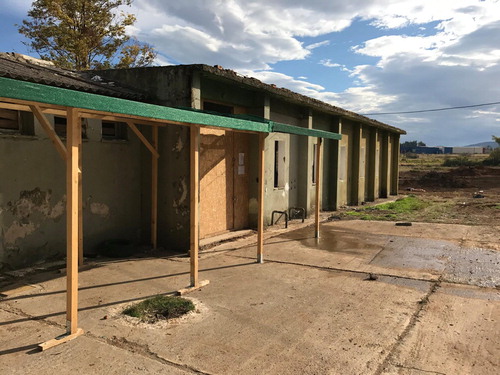
The wall before it was painted 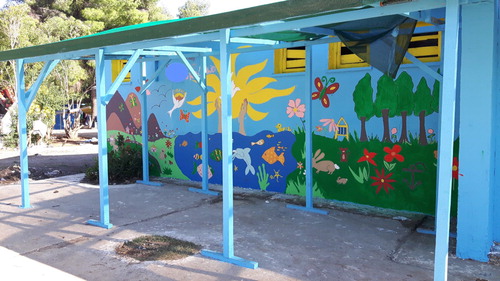
The wall after the mural was complete
 MA Art Therapy Blog